What Is Kaizen? The Continuous Improvement Method Explained, With Examples
Kaizen explained: what it means, how to run an idea system and a kaizen event, the 8 wastes to look for, examples, and how to track what each change saved.
Key takeaways
- Kaizen (改善) is Japanese for "change for the better". In lean, it means continuous improvement through many small changes made by the people who do the work.
- It comes in two forms: daily kaizen, a steady flow of small ideas from everyone, and kaizen events, focused workshops of 3 to 5 days on one process.
- Every idea follows plan, do, check, act: measure before, make the change, measure after, and only then make it the new standard.
- Look for the 8 wastes (TIMWOODS) and record what each change saved in time, money or quality.
What kaizen means
Kaizen comes from two Japanese words: kai (change) and zen (good). In business it means continuous improvement: making work a little better every day, mostly through small, low-cost changes suggested by the people closest to the work. It became known around the world through Toyota and through Masaaki Imai's 1986 book Kaizen: The Key to Japan's Competitive Success.
Kaizen is the opposite of waiting for one big project to fix everything. Hundreds of small improvements, such as a tool moved closer, a form with two fewer fields or a checklist at a machine, add up. Just as important, they build a habit of improving.
| Kaizen | Big improvement projects |
|---|---|
| Small steps, often | Large leaps, now and then |
| Little or no cost | Large investment |
| Everyone takes part | Specialists or consultants |
| Improves the existing process | Replaces it with new technology |
| Continuous | One-off |
The principles behind kaizen
- Go to gemba. Improve where the work happens, by looking at it, not from a meeting room.
- Small steps, often. A 1% improvement this week is worth more than a perfect plan next year.
- Everyone improves. The people doing the work see most of the waste.
- Facts, not opinions. Measure before and after.
- Fix the process, not the person. Problems are chances to improve, not occasions for blame.
- Standardize, then improve again. Today's improvement is tomorrow's standard, and the starting point for the next one.
How a kaizen idea works: plan, do, check, act
Every improvement, small or large, follows the PDCA cycle:
The step most teams skip is the last one. If the new way isn't written into the work instructions and taught to everyone, the process drifts back within weeks.
The 8 wastes to look for (TIMWOODS)
Most kaizen ideas remove one of eight kinds of waste. Taiichi Ohno's original Toyota list had seven; unused skills was added later, which gives the memory aid TIMWOODS.
| Waste | What it looks like | Example kaizen |
|---|---|---|
| Transportation | Moving material or information more than needed | Put the label printer next to the packing table |
| Inventory | More stock or work in progress than needed | Minimum and maximum levels marked on the shelf |
| Motion | People reaching, walking and searching | A shadow board for tools at the point of use |
| Waiting | People or machines idle, waiting for parts, approvals or information | Orders under $500 no longer wait for the weekly approval meeting |
| Overproduction | Making more, or earlier, than needed | Build to the day's orders instead of the forecast |
| Overprocessing | More work than the customer needs | Remove a duplicate data-entry step |
| Defects | Errors, scrap and rework | A go/no-go gauge that makes the error impossible (poka-yoke) |
| Skills | Ideas and knowledge that nobody asks for | A weekly 10-minute idea huddle |
Daily kaizen: running an idea system
Daily kaizen is a steady flow of small ideas from everyone. It lives or dies on how ideas are handled:
- Make it easy to submit. A card, a board or a short form that takes two minutes.
- Answer fast. Every idea gets a decision within a week, even if the answer is no, with the reason.
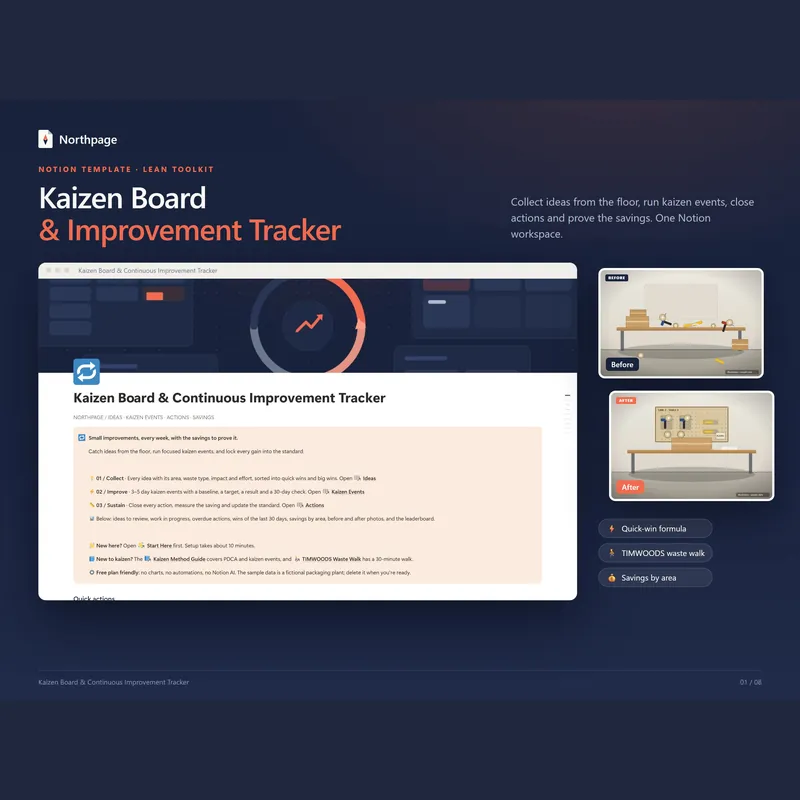
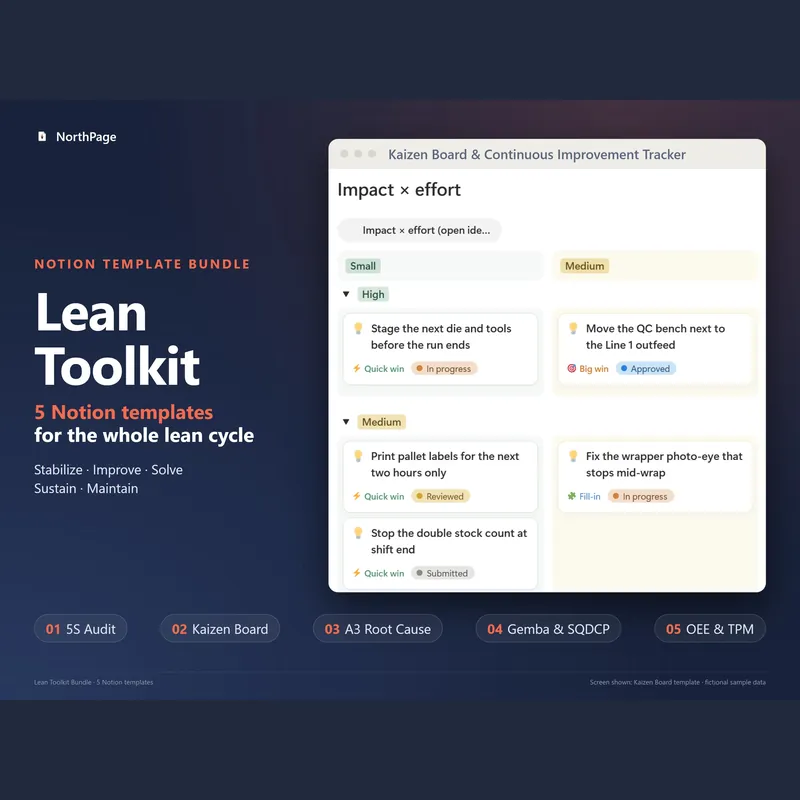
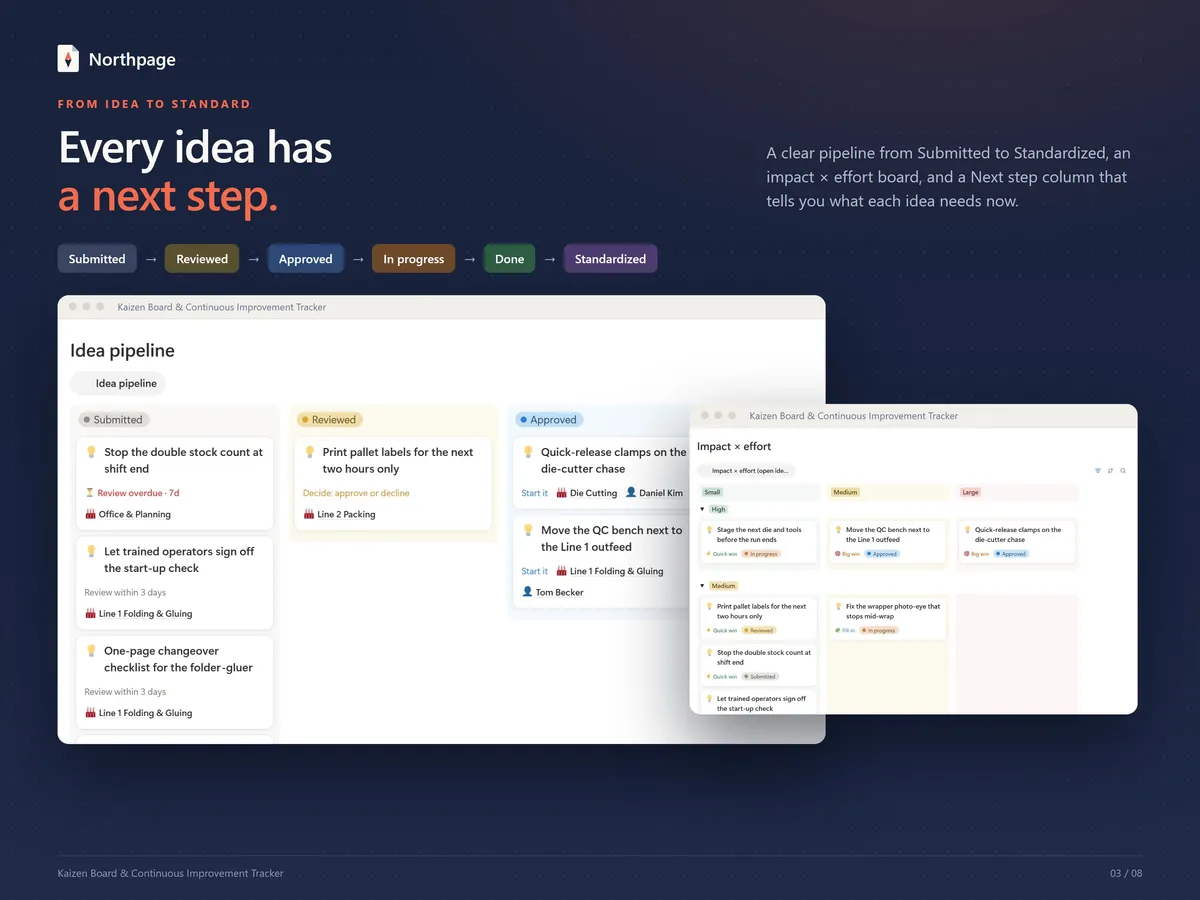
- Sort by impact and effort. High impact and low effort first: those are your quick wins.
- Let the person who suggested it make the change wherever possible, with help if needed.
- Measure before and after, even roughly.
- Standardize and share, so other areas can copy the idea.
- Recognize people. A thank-you and the result on the board matter more than prizes.
A simple pipeline keeps ideas from getting lost: Submitted → Reviewed → Approved → In progress → Done → Standardized, with a named next step for every idea that isn't finished.
Kaizen events (kaizen blitz)
A kaizen event is a focused workshop, usually 3 to 5 days, in which a small cross-functional team improves one process. A typical plan:
| When | Focus |
|---|---|
| Before | Choose the process, the scope, the team and a target; collect baseline data |
| Day 1 | Learn the method, walk the process and map how it works today |
| Day 2 | Find the waste and its causes; generate ideas |
| Day 3 | Try changes on the floor |
| Day 4 | Measure, refine and write the new standard work |
| Day 5 | Present the results to leaders and list the follow-up actions |
| 30 days later | Check that the results held |
Events bring fast, visible change; daily kaizen keeps it going. Most sites need both.
Kaizen examples
Typical examples from different workplaces (the numbers are illustrative):
- Factory changeover: a product change took 45 minutes while the operator fetched tools and parts. Staging them on a cart before the machine stops cut it to 20 minutes.
- Warehouse: the 20 fastest-moving items moved to the shelves next to packing, cutting pickers' walking by a third.
- Office: purchase orders under $500 waited for a weekly approval meeting. A rule letting the team lead approve them cut approval time from 6 days to 1.
- Hospital ward: nurses searched several rooms for supplies. One standard, labeled supply cart per corridor ended the search.
- Quality: parts were sometimes fitted the wrong way round. A small locating pin on the fixture made it impossible.
How to track what kaizen saves
Measure the change in its own unit first (minutes, defects, steps, meters), then turn it into money where that helps:
For the changeover above: 25 minutes saved × 4 changeovers a week × 48 weeks = 4,800 minutes, or 80 hours a year. At $35 an hour that is $2,800 a year, from one cart.
Be honest about the type of saving. Hard savings remove a cost you actually stop paying, such as scrap, overtime or a rented forklift. Soft savings free up time for other work. Both count, but report them separately, and track quality and safety gains that don't convert to money at all.
Why kaizen programs stall
- Ideas that never get an answer. The fastest way to stop suggestions is to ignore them.
- Only managers improve. Kaizen needs the people who do the work.
- No baseline. Without a "before" number nobody can show the change worked.
- Changes that aren't standardized. The old way comes back within weeks.
- Chasing only big savings. Small wins keep the habit alive; big ones are rare.
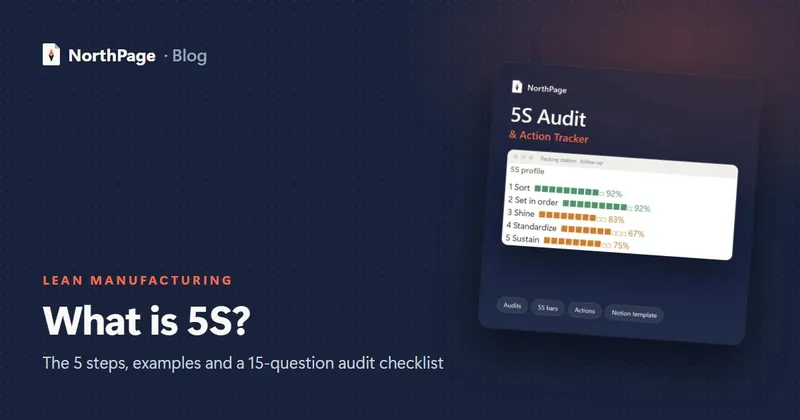
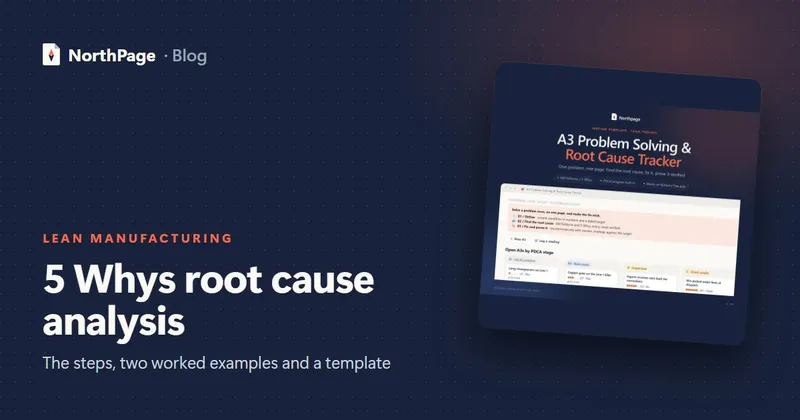
Kaizen works best on a stable base. See our guides to 5S, 5 Whys root cause analysis and calculating OEE.
Frequently asked questions
What does kaizen mean?
Kaizen is Japanese for "change for the better", from kai (change) and zen (good). In business it means continuous improvement: many small, low-cost changes, suggested and made by the people who do the work.
What is the difference between kaizen and lean?
Lean is a way of running operations that focuses on customer value and removing waste. Kaizen is the improvement habit at its core: the steady stream of small changes that keeps removing waste once the lean tools are in place.
What is a kaizen event?
A kaizen event, also called a kaizen blitz, is a focused workshop of usually 3 to 5 days in which a small cross-functional team studies one process, tries changes on the spot and writes the new standard. It gives fast, visible results; daily kaizen keeps them going.
What are examples of kaizen?
Moving a tool to where it is used, pre-staging parts before a changeover, removing a duplicate data-entry step, adding a checklist or a go/no-go gauge, or letting small orders skip a weekly approval meeting. Each one is small; together they add up.
How do you measure kaizen results?
Measure the process before and after the change in its own unit (minutes, defects, steps, distance), then convert to money where it helps: time saved per year multiplied by the labor rate. Keep hard savings, where cost was actually removed, apart from soft savings, where time was freed for other work.