5 Whys Root Cause Analysis: How to Do It Right, With Examples and a Template
How to use the 5 Whys to find a root cause: the steps, two worked examples, the mistakes that stop at blame, and when to use a fishbone or an A3 instead.
Key takeaways
- The 5 Whys means asking "why?" until you reach a cause that, once fixed, stops the problem from coming back. Five is a guide, not a rule.
- Start from a problem stated in facts and numbers, and check each answer where the problem happens, not in a meeting room.
- A real root cause is a process or system condition. "Human error" is where the questions should continue, not stop.
- When a problem could have several causes, sort them on a fishbone (6M) diagram first, then run a 5 Whys chain on each cause the data supports.
What the 5 Whys is
The 5 Whys is a simple root cause analysis technique. You state a problem, ask why it happened, then ask why again about the answer, until you reach a cause you can fix. It is credited to Sakichi Toyoda, the founder of Toyota Industries, and Taiichi Ohno made it a shop-floor habit as part of the Toyota Production System. Today it is one of the basic tools of lean and quality management.
The number five is a guide. Some problems reach their root cause in three whys, others need six or seven. The point is to keep going past the first obvious answer, which is usually a symptom.
How to do a 5 Whys analysis in 6 steps
- State the problem in facts. What happened, where, when and how much, against which target. "Line 2 label rejects were 4.2% in week 32 against a 0.5% target" is a problem statement. "Labels are a mess" is not.
- Go and see. Look at the process where the problem happens, with the people who do the work. Most wrong root causes come from guessing in a meeting room.
- Ask why, and write the answer as a fact. Then check it with a measurement, an observation or a record. If you can't verify an answer, it is a hypothesis, not a link in the chain.
- Repeat until you reach a cause you can act on. A good test: if we fix this, would the problem stop coming back? If the answer is "only for a while", keep asking.
- Read the chain backwards. Start at the root cause and connect each answer upwards with "therefore". If the chain still makes sense, the logic holds.
- Fix, check and standardize. Put a countermeasure on the root cause, plus a quick containment for now. Measure whether the problem drops, and make the fix part of the standard way of working.
Example 1: misaligned labels on a packing line
Problem: on Line 2, 4.2% of cartons in week 32 had labels more than 3 mm out of position, against a target of 0.5%.
| Why? | Answer | How it was checked |
|---|---|---|
| 1. Why are the labels out of position? | The label web drifts sideways during a run. | Label position measured every 30 minutes for two shifts |
| 2. Why does the web drift? | The roll guide on the applicator is loose. | Seen at the machine: the guide moves by hand |
| 3. Why is the guide loose? | It is adjusted at every roll change, and its thumb screw is worn. | Maintenance records and the worn screw itself |
| 4. Why is it adjusted so often? | Roll changes went from 2 to 6 per shift after a switch to smaller label rolls. | Purchasing records and the shift log |
| 5. Why did the roll size change? | Purchasing changed supplier to cut cost, and material changes aren't reviewed with production. | The supplier change record has no production sign-off |
Root cause: material changes are made without a review by production, so their effect on the line goes unseen.
Countermeasures: replace the thumb screw with a locking guide (containment), go back to the larger roll size, and add a production sign-off to the material change process (the root cause fix).
Stopping at why 2, "tighten the guide", would have brought the problem back within weeks.
Example 2: late invoices in an office
Problem: in October, 23% of invoices were sent more than 5 days after delivery, against a target of under 5%.
| Why? | Answer | How it was checked |
|---|---|---|
| 1. Why are invoices late? | Billing waits for proof of delivery before invoicing. | The billing procedure and a sample of 40 late invoices |
| 2. Why does proof of delivery arrive late? | Signed delivery notes reach the office once a week. | Dates on the scanned notes |
| 3. Why only once a week? | Drivers bring paper notes back to the depot, where they are scanned in a batch on Fridays. | Observed at the depot |
| 4. Why are the notes on paper? | The drivers' delivery app records the stop but can't capture a signature. | App settings checked with IT |
| 5. Why can't the app capture a signature? | When the app was set up, billing's need for proof of delivery wasn't in the requirements. | The original project brief |
Root cause: billing's needs weren't part of the delivery app's requirements.
Countermeasures: scan delivery notes daily (containment), turn on signature or photo capture in the app (the fix), and add billing to the review list for changes to delivery systems.
Common 5 Whys mistakes
- Stopping at a person. "The operator forgot" is never the root cause. Ask why the process let a person forget: no checklist, no error-proofing, an unclear standard.
- Guessing instead of checking. Every answer needs evidence. A chain built on assumptions points to the wrong fix with great confidence.
- A vague problem statement. "Quality is bad" leads to a vague chain. Use numbers, a place and a time.
- Forcing one chain on a problem with several causes. Many problems have two or three contributing causes. Follow each one in its own chain.
- Going too far. "Because of the economy" is outside your control. Stop at the deepest cause your team can act on.
- Starting from the solution. If the group already "knows" the answer, the whys get bent to fit it.
5 Whys and the fishbone diagram
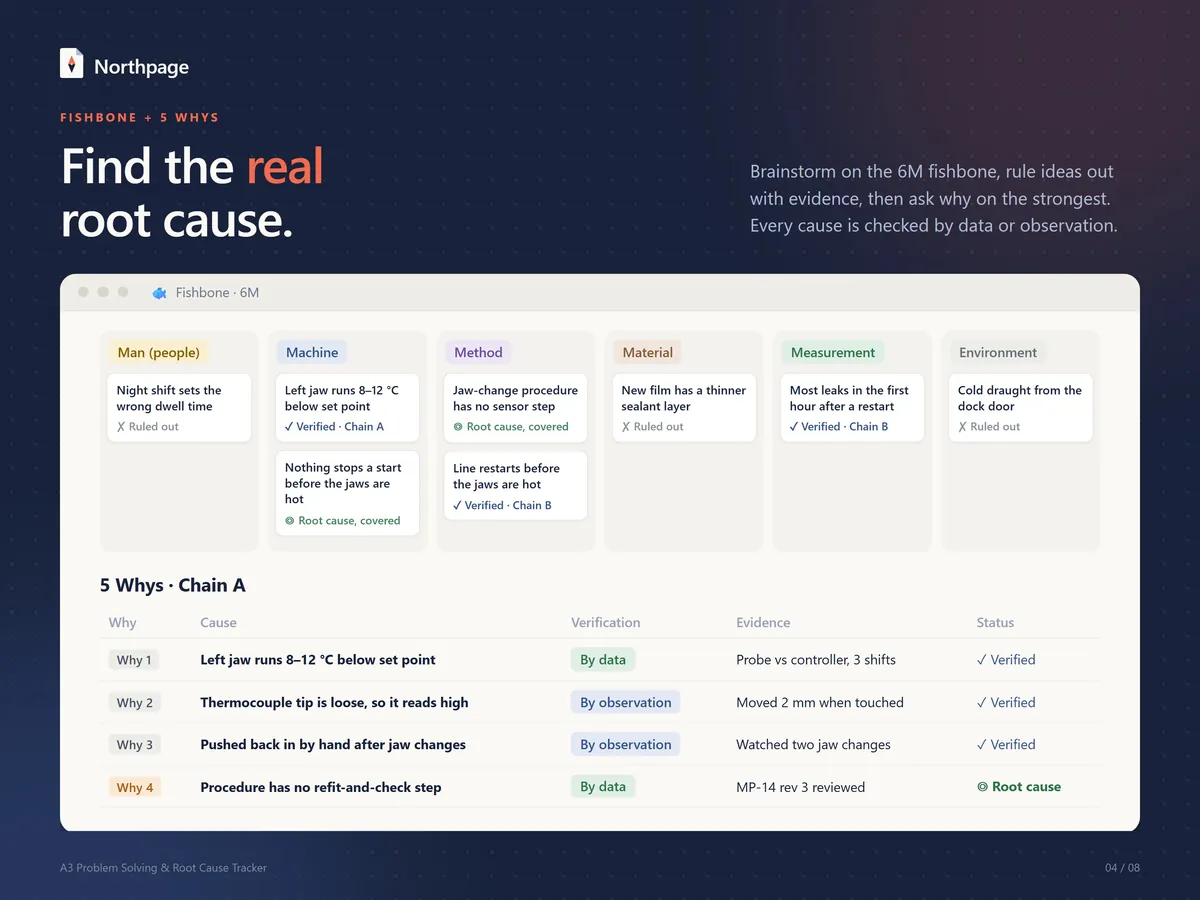
The 5 Whys follows one line of cause and effect. When a problem could have many causes, start wider with a fishbone (Ishikawa) diagram: write the problem at the head and list possible causes along six bones, often called the 6Ms.
| 6M | Ask about |
|---|---|
| Man (people) | Training, experience, workload, communication |
| Machine | Equipment condition, settings, wear, tooling |
| Method | Procedures, standards, the sequence of work |
| Material | Raw material, parts, supplier changes |
| Measurement | Gauges, calibration, how the data is collected |
| Mother Nature (environment) | Temperature, humidity, light, dust |
Then use data or observation to rule causes in or out, and run a 5 Whys chain on each cause that survives. The fishbone keeps you from missing a cause; the 5 Whys keeps you from stopping at a symptom.
When to use an A3 instead
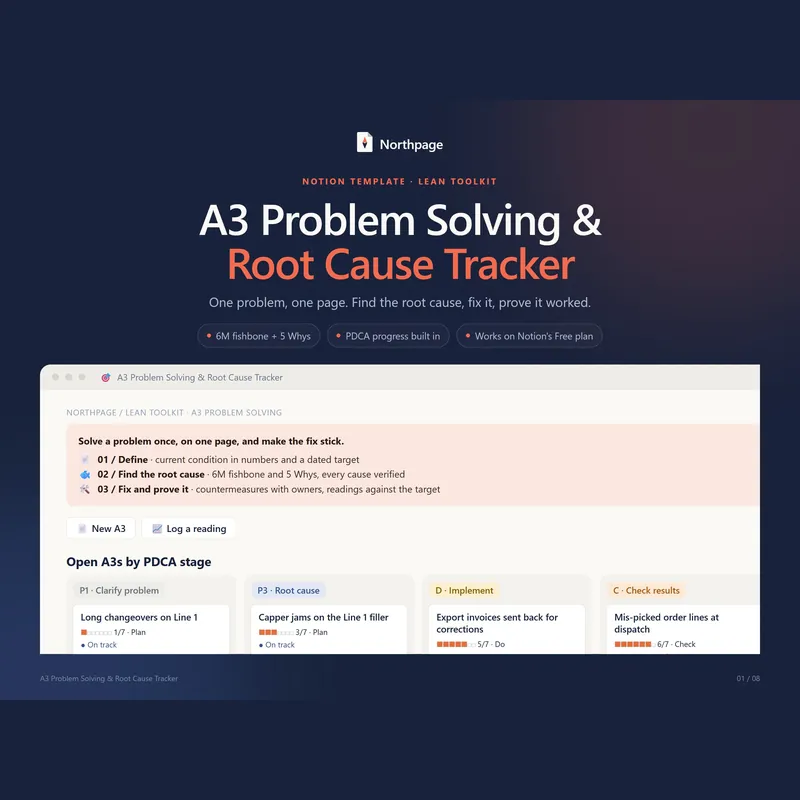
For a small, local problem, a 5 Whys on a whiteboard is enough. For a problem that is costly, keeps coming back or crosses departments, use an A3: a one-page problem-solving report named after the paper size. A classic A3 has eight sections:
- Background: why this problem matters
- Current condition: the facts and numbers today
- Goal: the target, and by when
- Root cause analysis: the fishbone and the 5 Whys
- Countermeasures
- Plan: who does what, by when
- Check: did the numbers move?
- Standardize and share
The A3 follows the plan, do, check, act (PDCA) cycle, so the 5 Whys sits inside a process that ends with proof that the fix worked.
5 Whys template
Copy this structure into a document, onto a whiteboard or into your team's tool:
| Field | What to write |
|---|---|
| Problem statement | What, where, when and how much, against which target |
| Why 1 to Why 5 | Each answer as a fact, plus how it was checked |
| Root cause | The deepest cause you can act on that stops the problem coming back |
| Containment | What protects the customer or the next process right now |
| Countermeasure | The fix for the root cause, with an owner and a due date |
| Check | The date you will measure again, and the result |
| Standardize | What changes in the standard, the training or the checklist |
Problems that come back on the shop floor often show up first in a 5S audit or in OEE losses. See our guides to 5S and calculating OEE.
Frequently asked questions
Why is it called the 5 Whys?
Because asking "why" about five times is usually enough to get past the symptoms to a cause you can fix. The number is a rule of thumb from Toyota, not a fixed requirement.
Do you always have to ask exactly five whys?
No. Stop when you reach a cause that you can act on and that, once fixed, stops the problem from coming back. That can take three whys or seven.
What is the difference between root cause analysis and the 5 Whys?
Root cause analysis is the general practice of finding the underlying causes of a problem. The 5 Whys is one of its techniques, alongside the fishbone diagram, Pareto charts and fault tree analysis.
Who should take part in a 5 Whys analysis?
The people who do the work where the problem happens, someone who knows the process or equipment well, and a facilitator who keeps the group on facts. Three to six people is a good size.
What comes after the 5 Whys?
A countermeasure for the root cause, a check that the problem has really dropped, and an update to the standard so the fix lasts. An A3 report keeps all of these steps on one page.